

Disclaimer

Delivery

Overview

Physical delivery refers to the close-out of an open position in an expired futures contract by the buyer and the seller through a transfer of the ownership of the commodity underlying the contract. 
More

Process

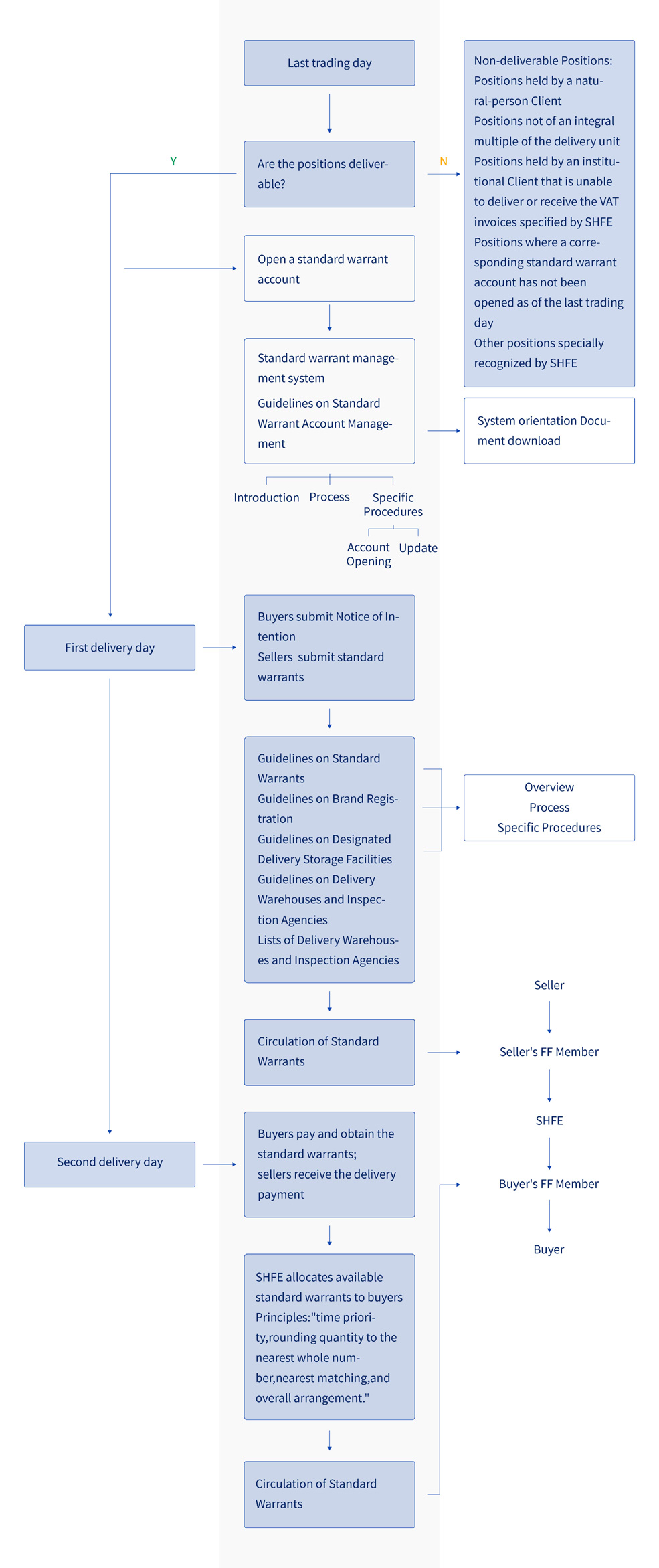
Buyers submit Notice of Intention and sellers submit standard warrants; SHFE allocates available standard warrants to buyers; buyers make payments and obtain the warrants; sellers receive the payment.
More

Non-Deliverable Positions

Overview

Definition: Non-deliverable positions include positions held by a natural-person Client, positions not of an integral multiple of the delivery unit, positions held by an institutional Client that is unable to deliver or receive VAT invoices, positions where a corresponding standard warrant account has not been opened as of the last trading day, and other positions specially recognized by SHFE. 
More

Process

After market close on the last trading day of a futures contract, outstanding non-deliverable positions will be handled in the following sequence: 
1.  SHFE will impose a fine equaling 20 percent of the contract value calculated at the final settlement price on each of the buyer and the seller holding the non-deliverable positions;
2.  Based on the disparity in the non-deliverable positions held by the buyer and the seller and whichever party holding a larger position, SHFE will pay an amount equaling 20 percent of the contract value calculated at the final settlement price to the counterparty holding the deliverable positions;
3.  The open positions described in (1) and (2) will be closed out without proceeding to delivery. 
More

Standard Warrants

Overview

"Standard warrant" refers to a certificate for taking delivery of commodities that is issued by a Delivery Storage Facility to the owner of the commodities via SHFE's Standard Warrant Management System. SHFE futures contracts are all delivered through electronic standard warrants. 
More

Process

The most common standard warrant-related processes for non-ferrous metals, precious metals, ferrous metals, and petrochemical futures are the creation and cancellation of standard warrants. Rules governing such processes mainly include:
More

Procedures

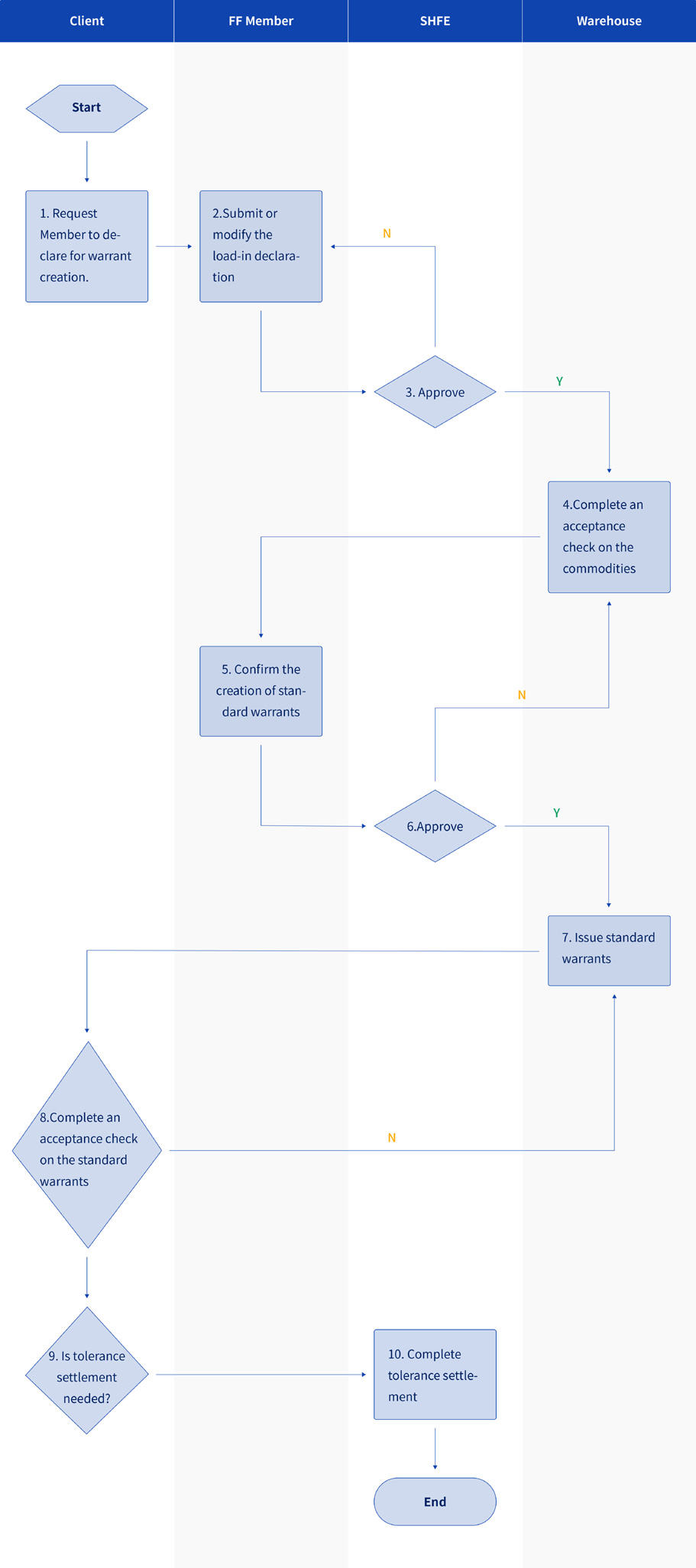
Creation of standard warrants (non-ferrous metals, precious metals, ferrous metals, natural rubber, woodpulp, offset paper)
Description
1.  The Client requests its carrying Member to make filings for warrant creation;
2.  The Member submits load-in declaration to SHFE via the electronic warrant system;
3.  SHFE reviews the request. If rejected, the Member may revise the declaration until it meets the relevant requirements;
4.  Upon approval, the Delivery Warehouse completes an acceptance check on the load-in commodities and related documents and fills out an application for creation of standard warrants;
5.  The Member confirms the creation application;
6.  SHFE reviews the creation application. If rejected, the Delivery Warehouse may revise it;
7.  After approval, the Delivery Warehouse creates and issues the standard warrants;
8.  The Client checks and accepts the standard warrants. If the standard warrants are unsatisfactory, they will be returned to the Delivery Warehouse for re-creation;
9.  The Client determines whether tolerance settlement is needed. If not, the electronic standard warrants take effect and the process terminates;
10.  If tolerance settlement is needed, SHFE will handle settlement and confirms the results.
 
Rules
 
Flowchart

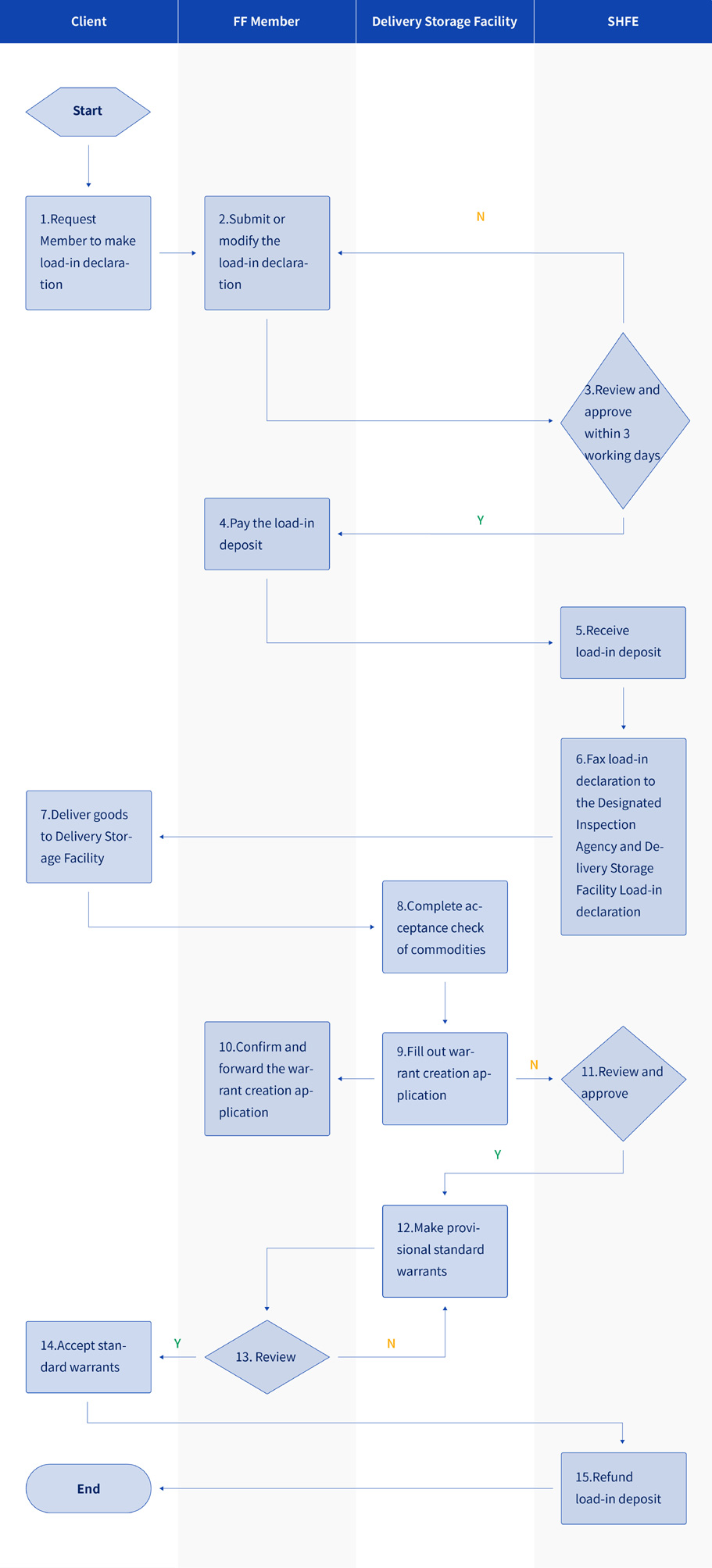
Creation of standard warrants (fuel oil and bitumen)
Description
1.  The Client requests its carrying Member to make filings for load-in declaration;
2.  The Member submits load-in declaration (electronic and paper) to SHFE;
3.  SHFE reviews the load-in declaration within three days. If rejected, it will be returned to the Member who may re-apply; if approved, the Member may pay the load-in deposit;
4.  The Member pays the load-in deposit;
5.  SHFE collects the load-in deposit;
6.  SHFE and the Member fax the load-in declaration to the Designated Inspection Agency and Delivery Storage Facility;
7.  The Client delivers goods to the Delivery Storage Facility;
8.  The Delivery Storage Facility checks the goods and the Designated Inspection Agency issues a quality inspection report;
9.  The Delivery Storage Facility completes an application for creation of standard warrants;
10.  The Member confirms and forwards the creation application;
11.  SHFE reviews and approves the creation application;
12.  The Delivery Storage Facility revises the creation application if necessary;
13.  The Delivery Storage Facility creates the provisional standard warrants and notifies the Member for review. If revision is needed, the standard warrants will be returned and remade;
14.  The Client checks and accepts the standard warrants;
15.  SHFE refunds the Member's load-in deposit after receiving the original copy of the quality inspection report.
 
Forms and Materials
 
Rules
 
Flowchart 

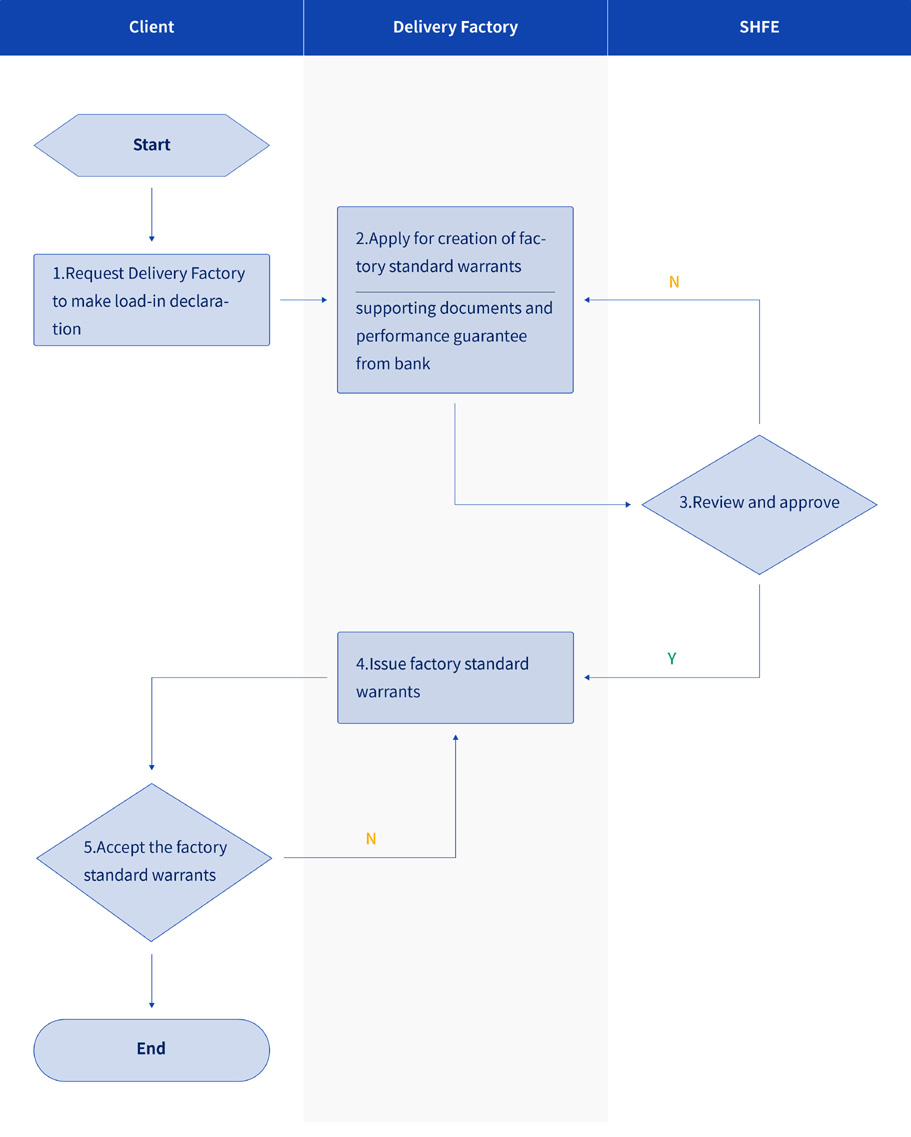
Creation of factory standard warrants (aluminum oxide, steel rebar, wire rod, hot-rolled coil, stainless steel, bitumen, butadiene rubber, woodpulp, and offset paper)
Description
1.  The Client requests the factory to complete the load-in declaration;
2.  The factory applies to SHFE through the electronic warrant system for issuance of factory standard warrants and provides a performance guarantee issued by a bank or another form of payment guarantee recognized by SHFE;
3.  SHFE reviews the application. If rejected, the factory should revise the application until it meets the relevant requirements;
4.  Upon application's approval, the factory issues the factory standard warrant;
5.  The Client checks and accepts the factory standard warrants. If revision is needed, they will be returned to the factory for re-creation;
 
Rules
 
Flowchart
 

Cancellation of standard warrants

Description
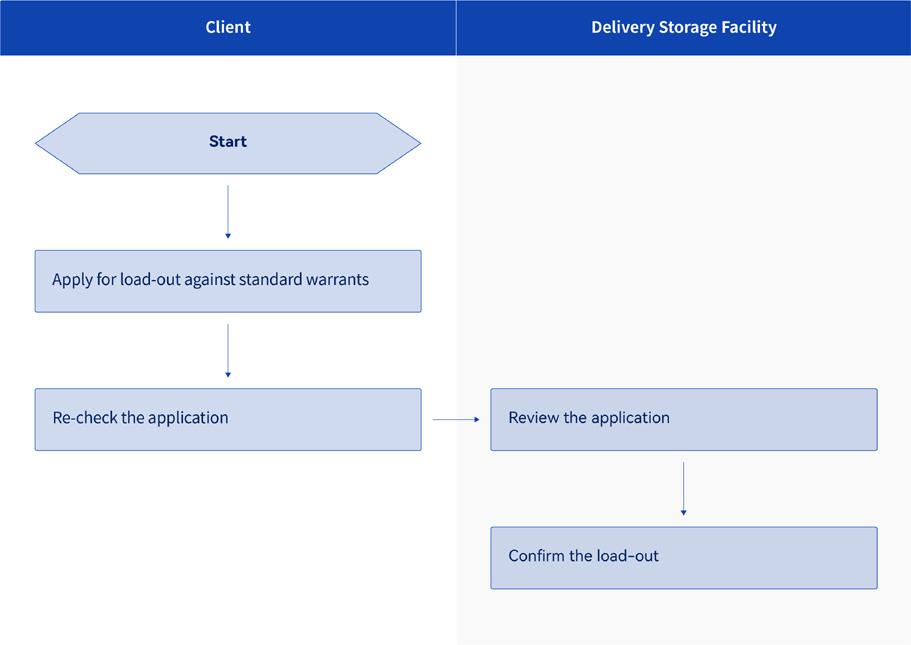
1.  The owner applies to the Delivery Storage Facility for cancellation of standard warrants via the electronic warrant system. If load-out is needed, the application should also specify the take-delivery method;
2.  The Delivery Storage Facility reviews the load-out application;
3.  The Client confirms the cancellation of standard warrants at the Delivery Storage Facility. The Delivery Storage Facility then produces a confirmation of load-out against standard warrants for signature confirmation by the delivery-taker;  
4.  The owner completes the take-delivery.
 
Rules
 
Flowchart 

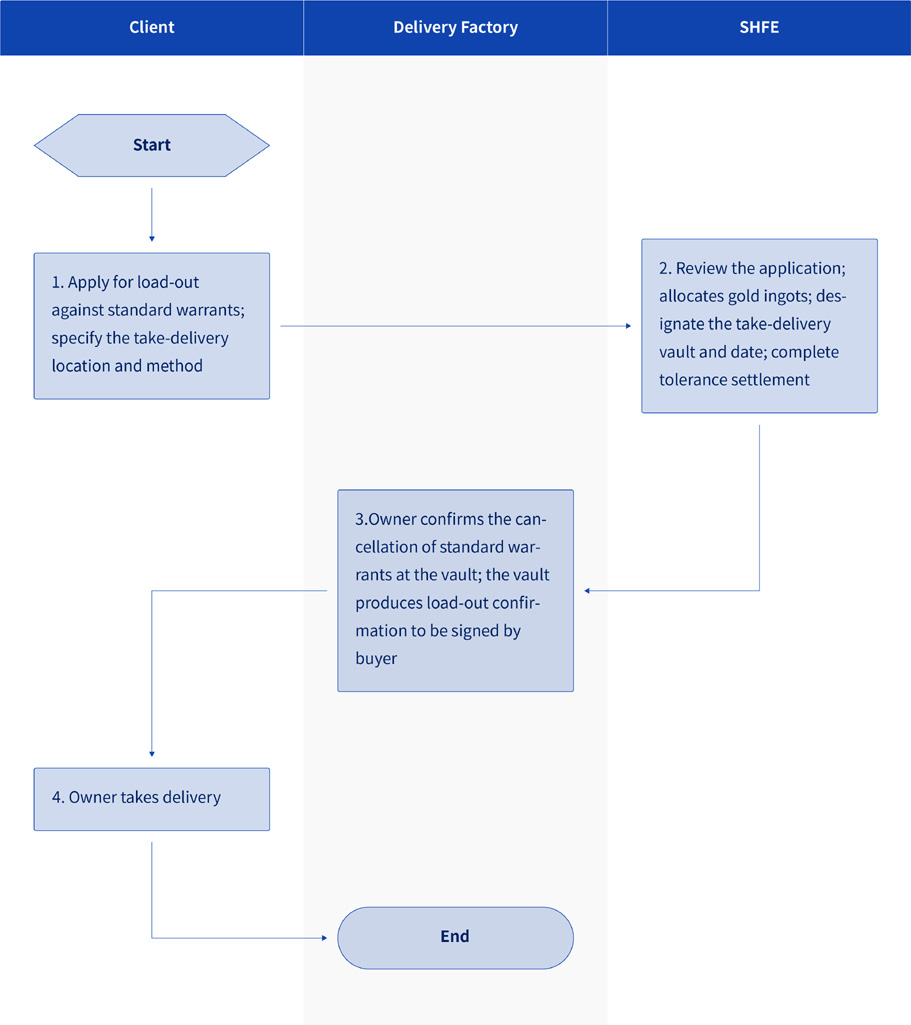
Cancellation of standard warrants (gold)
Description
1.  The owner applies for cancellation of standard warrants via the electronic warrant system and selects a take-delivery location;
2.  SHFE reviews the application, designates the take-delivery vault and date, and allocates gold ingots for tolerance settlement;
3.  The Client confirms the cancellation of standard warrants at the vault. The vault then produces a confirmation of load-out against standard warrants for signature confirmation by the delivery-taker;
4.  The owner completes the take-delivery.
 
Rules
 
Flowchart 

Cancellation of standard factory warrants (aluminum oxide, steel rebar, wire rod, hot-rolled coil, stainless steel, bitumen, butadiene rubber, woodpulp, and offset paper)
Description
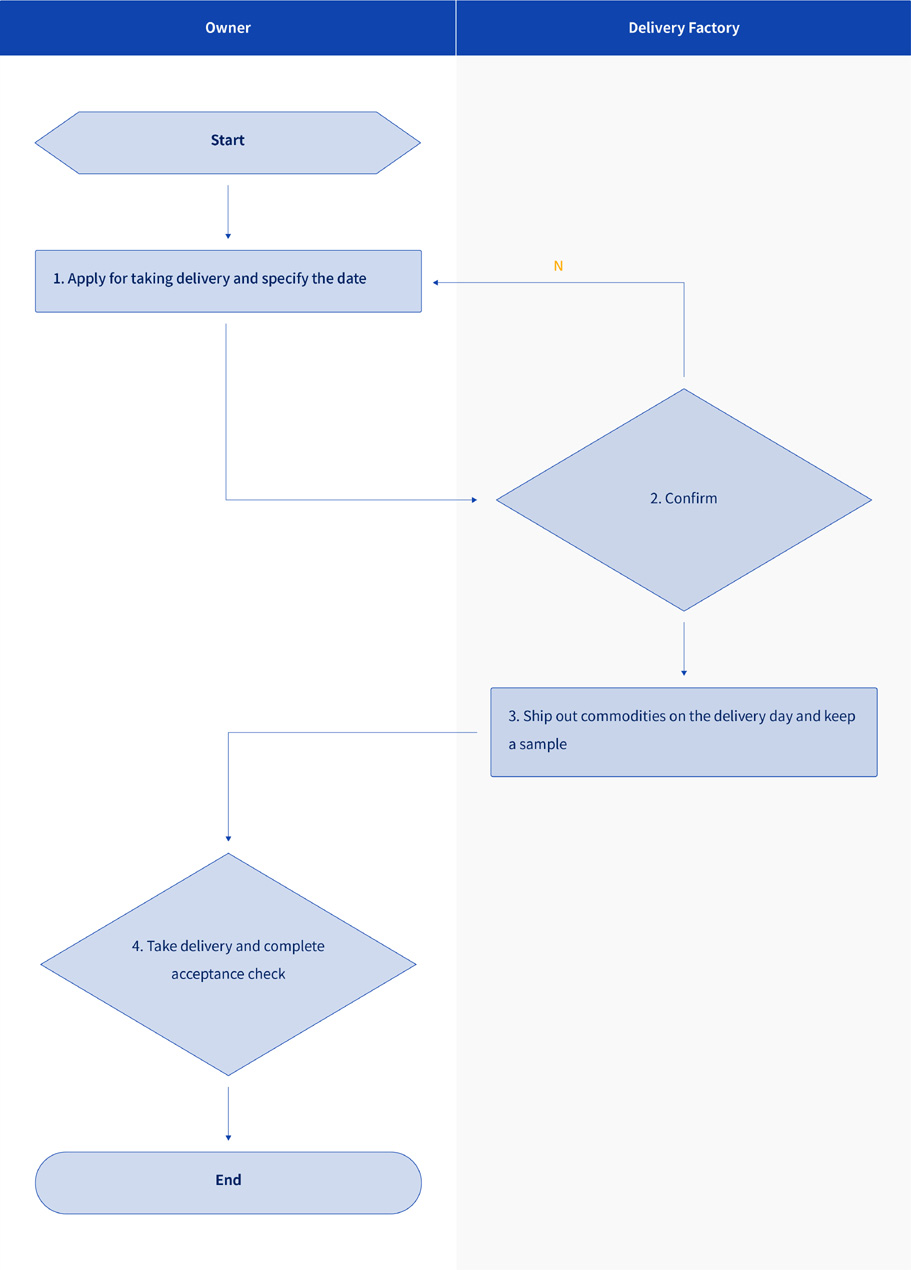
1. The owner applies to the factory for cancellation of standard warrants via the electronic warrant system. if load-out is needed, the application should also specify the take-delivery method;
2.  The factory reviews the cancellation application;
3.  The owner confirms the cancellation of standard warrants in the Standard Warrant Management System. The factory then produces the confirmation of load-out against standard warrants;
4.  The owner completes the take-delivery at the factory.
 
Rules
 
Flowchart 

Contact information

  Non-ferrous metals:
  Natural rubber:
 Precious metals:
  Ferrous metals:
  Woodpulp and offset paper:
  Fuel oil and bitumen:
More

Management of Standard Warrant Accounts

Overview

SHFE's day-to-day management over standard warrant accounts includes opening and update of standard warrant accounts. 
More

Process

Standard warrant management involves one process, i.e., opening of standard warrant accounts. 
More

Procedures

Opening of standard warrant accounts
Description
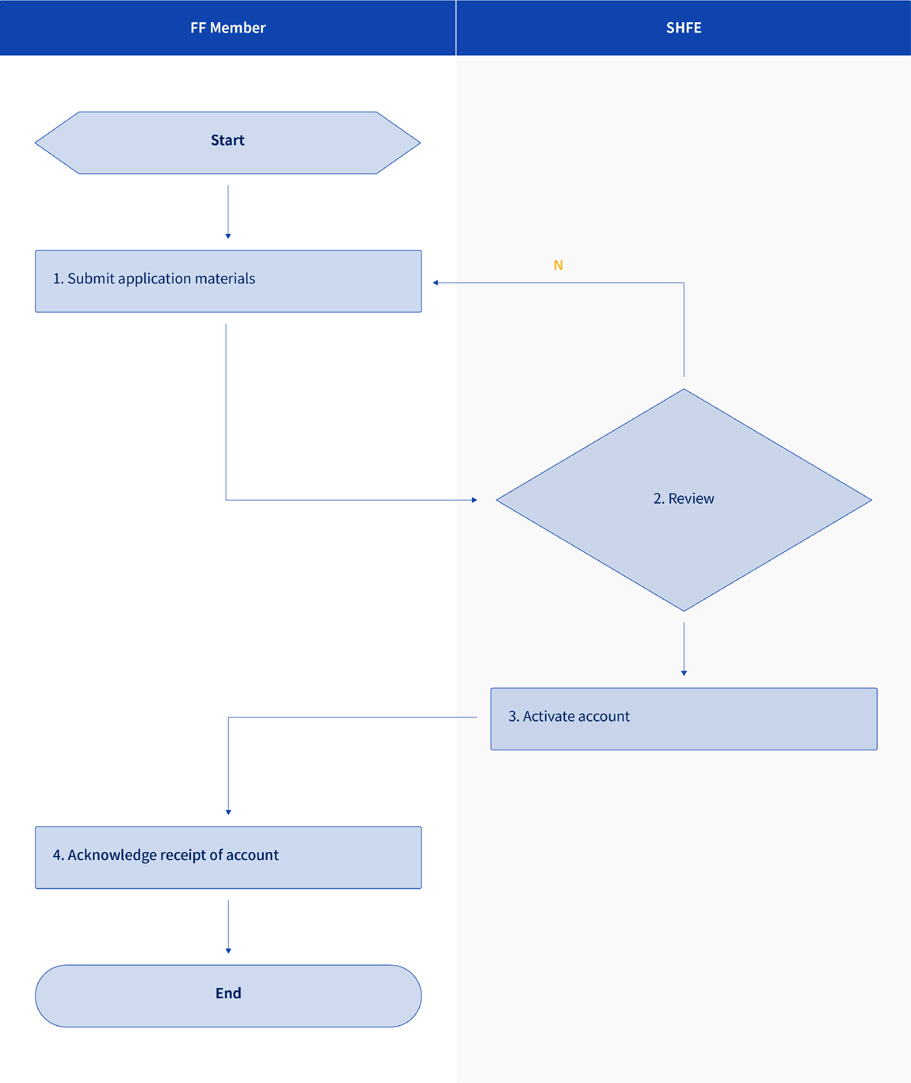
1.  Documents to be filed: photocopy of the Business License, certificate of general VAT taxpayer, and photocopy of the ID cards of the legal representative and account-opening agent. Photocopied documents should be affixed with the official seals of the applicant and the FF Member;
2.  Two copies each of the Standard Warrant Account Opening and Registration Form, Table of Information on Users of SHFE Warrant System (Client), and Service Agreement on Users of SHFE Standard Warrant Management System. The Service Agreement should be signed by the investor's legal representative (Party A) and affixed with the applicant's official seal;
3.  For banks and other financial institutions that handle secured loans, photocopy of the Financial License and the document issued by higher authority on approval of opening the standard warrant account should also be provided. All documents to be filed must be affixed with official seals;
4.  SHFE reviews the foregoing documents and activates the account in the standard warrant system within 10 business days;
5.  The Member receives the account opening materials, encryptor, and standard warrant business card and confirms the receipt with signature.
 
Forms and Materials
 
Rules
 
Flowchart 

Update of standard warrant accounts

Description
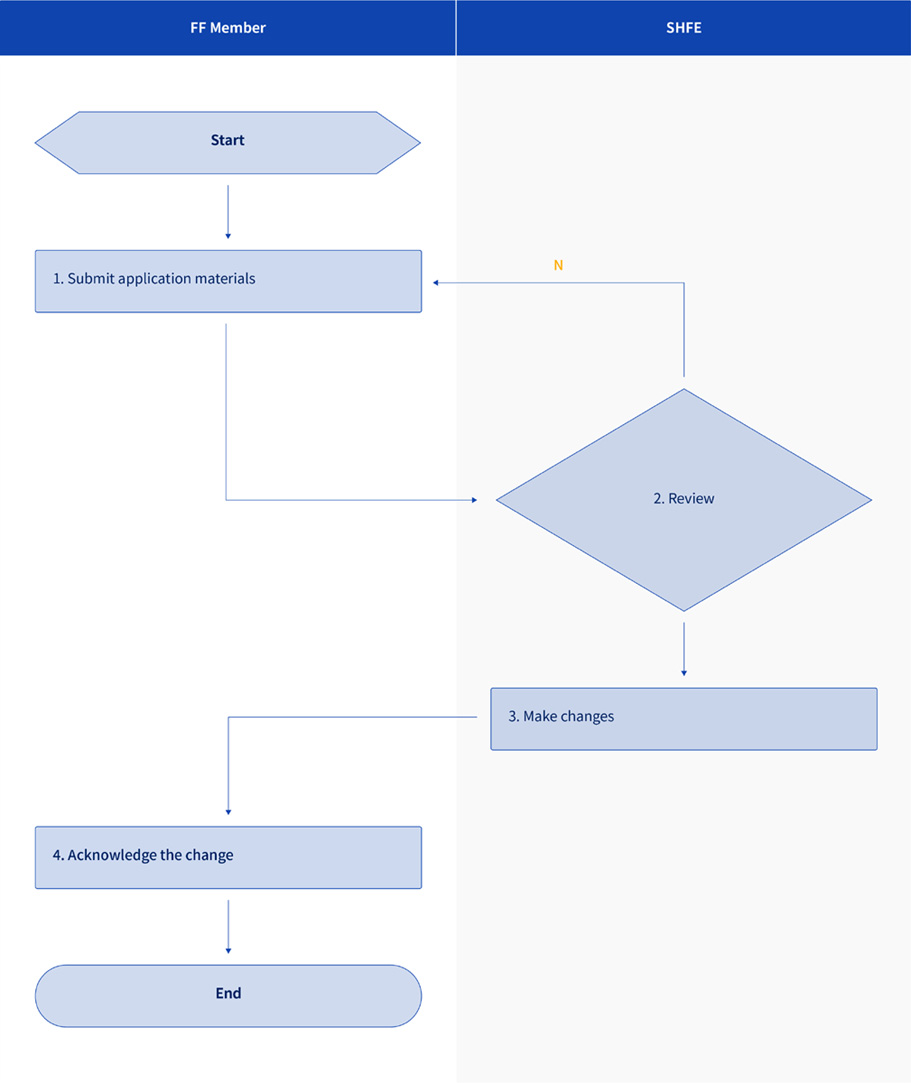
1.  Documents to be filed with SHFE: photocopy of the Business License, photocopy of the ID cards of the legal representative and authorized agent, and documentation relating to the information to be updated. Photocopied documents should be affixed with the official seals of the applicant and the FF Member;
2.   For updating existing information, the Client should fill out the Application Form for Change of Standard Warrant Account (signed and sealed), indicating the information to be changed and the reason for such change. For adding a new user, the Client should complete the Table of Information on Users of SHFE Warrant System (Client) (signed and sealed);
3.  For updating existing information, the Client's FF Member may review (on behalf of SHFE) the original documents provided by the Client. The FF Member should then issue its decision, affixed with its official seal and the signature of the responsible person;
4.  SHFE reviews the relevant materials and makes the necessary changes in the standard warrant account system within 10 business days.
 
Forms and Materials
 
Rules
 
Flowchart 

Contact information

More

Brand Registration (Certification)

Overview

To better manage the commodities for futures delivery and safeguard the legitimate rights and interests of each party involved in futures trading, SHFE implements a brand registration and certification system for the deliverables of non-ferrous metals, ferrous metals, precious metals, steel, and energy and chemical futures contracts. Producers of these products are required to register or certify their brands at SHFE before such products can be used for delivery. 
More

Process

Brand-related processes include brand registration (certification), brand update, and brand inspection and deregistration. They are chiefly regulated by the following rules:
•  Rules on Registration of Non-Ferrous Metal Products for Futures Delivery of the Shanghai Futures Exchange
•  Rules on the Registration and Recognition of Deliverable Aluminum Oxide of the Shanghai Futures Exchange
•  Rules on Registration of Precious Metal Products for Futures Delivery of the Shanghai Futures Exchange
•  Rules on Registration of Steel Products for Futures Delivery of the Shanghai Futures Exchange
•  Rules on Registration of Domestic Natural Rubber Products for Futures Delivery of the Shanghai Futures Exchange
•  Rules on Registration of Bitumen Products for Futures Delivery of the Shanghai Futures Exchange 
More

Procedures

Brand Registration (Certification)

Description
The following is a general description of the registration or certification procedures. The exact procedures vary from product to product; please refer to the corresponding product rules for details.
1.  The applicant submits a registration application and written registration materials to SHFE;
2.  SHFE performs a preliminary review of the registration materials;
3.  If the applicant passes the preliminary review, SHFE will work with a Designated Inspection Agency to perform on-site inspection of applicant's product quality and management system;
4.  If the applicant passes the on-site inspection, SHFE will forward and review the registration materials;
5.  SHFE evaluates each qualified applicant and determines whether to approve the registration based on the submitted materials, the results of product inspection, and the findings from trial use;
6.  Following this evaluation, SHFE approves and publicly announces the registration;
7.  The applicant completes the brand registration procedures and pays the registration fee before registration is formally approved.

Rules
 
List of Registered (Certified) Brands
Non-ferrous metals Copper   Aluminum   Zinc   Lead   Nickel   Tin   Aluminum oxide   Cast aluminum alloy
Precious metals : Gold   Silver 
Ferrous metals : Steel rebar   Wire rod   Hot-rolled coil
Energy & chemicals : Bitumen   Synthetic rubber   Natural rubber   Woodpulp   Offset paper
 
Flowchart

Brand update

Description
1.  The applicant submits a brand update application (due to corporate division, merger, trademark transfer, or alteration of external packaging, etc.), along with the supporting documents, to SHFE;
2.  SHFE performs a preliminary review of the materials;
3.  If the applicant passes the preliminary review, SHFE will work with a Designated Inspection Agency to perform an on-site inspection;
4.  If the applicant passes the on-site inspection, SHFE will review the brand update application;
5.  SHFE completes, registers, and publicly announces the brand update;
6.  SHFE notifies the applicant;
7.  The applicant completes registration and filing procedures and the change takes effect.
 
Rules
 
Flowchart 

Brand inspection and deregistration

Description
1.  SHFE collects product feedbacks and related market and media reports;
2.  SHFE works with a Designated Inspection Agency to conduct random and annual inspections on the branded products stored in Delivery Warehouses;
3.  The Designated Inspection Agency issues an inspection report on whether the products meet the relevant requirements;
4.  If not, SHFE notifies the brand to make corrections;
5.  The brand takes corrective actions;
6.  SHFE re-inspects the products;
7.  If quality issues still exist, SHFE will recommend the suspension of the brand for delivery purposes;
8.  SHFE reviews and approves the suspension;
9.  SHFE suspends the products of this brand from taking part in delivery and notifies the brand to implement a second round of rectification;
10.  The brand implements the second round of rectification;
11.  SHFE re-inspects the products;
12.  If quality is still unsatisfactory, SHFE will recommend the deregistration of the brand;
13.  SHFE issues a public notice on the deregistration.
 
Rules
 
Flowchart

Contact information

 Non-ferrous metals:

 Natural rubber:

 Precious metals:

 TSR 20:

 Ferrous metals:

 Woodpulp and offset paper:

  Bitumen:

More

Delivery Storage Facilities and Designated Inspection Agencies

Delivery Warehouses

Delivery Warehouses

To regulate and ensure an orderly delivery process, physical delivery against futures contracts is conducted at Delivery Storage Facilities designated by SHFE. A "Delivery Storage Facility" is a location designated by SHFE for the physical delivery of commodities in the performance of futures contracts. SHFE regulates futures-related activities at Delivery Storage Facilities in accordance with applicable rules.

Delivery Warehouses and Contact Information

Non-ferrous metals:
Precious metals:
Ferrous metals:
Energy:
Chemicals:

Quality inspection agencies

Overview

To ensure the quality of commodities for futures delivery and maintain a fair market, all products traded on SHFE should undergo quality inspections conducted by inspection agencies designated by SHFE. A "Designated Inspection Agency" refers to a third-party inspection agency that is recognized by SHFE for possessing the necessary qualifications and technical capabilities and is responsible for testing and certifying the quality, specifications, and other indicators of commodities for delivery. SHFE supervises the operational procedures and inspection standards of Designated Inspection Agencies in accordance with applicable rules.

Designated Inspection Agencies and Contact Information

Non-ferrous metals:
Precious metals:
Ferrous metals:
Energy:
Chemicals:
 

Process

Delivery Storage Facilities

Processes relating to Designated Delivery Storage Facilities include the creation and change of such storage facilities. These processes are mostly governed by the Delivery Storage Facility Rules of the Shanghai Futures Exchange.

More

Procedures

Creation of Delivery Storage Facilities
Description
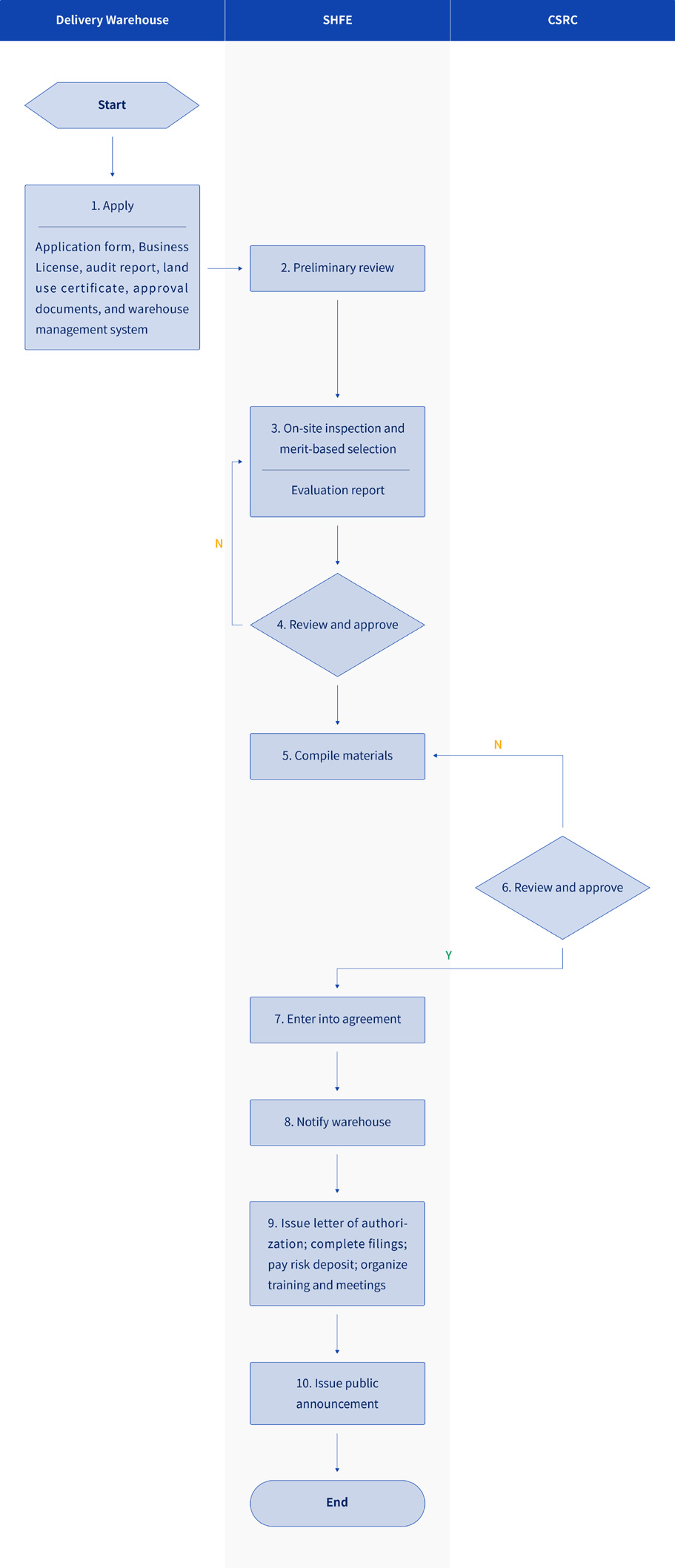
1.  The operator of the prospective Delivery Storage Facility submits an application and its supporting materials to SHFE;
2.  SHFE conducts a preliminary review of the operator and the proposed facility;
3.  If the application passes the preliminary review, SHFE will conduct an on-site inspection of the proposed facility; 
4.  If the findings from the on-site inspection are satisfactory, SHFE will forward the application materials to the CSRC and indicate its preliminary approval on the establishment of the Delivery Storage Facility;
5.  Following approval of the CSRC, SHFE completes the approval process and enters into an agreement with the operator;
6.  SHFE publicly announces the decision to conclude the process.

Flowchart

Change of Delivery Storage Facilities
Description
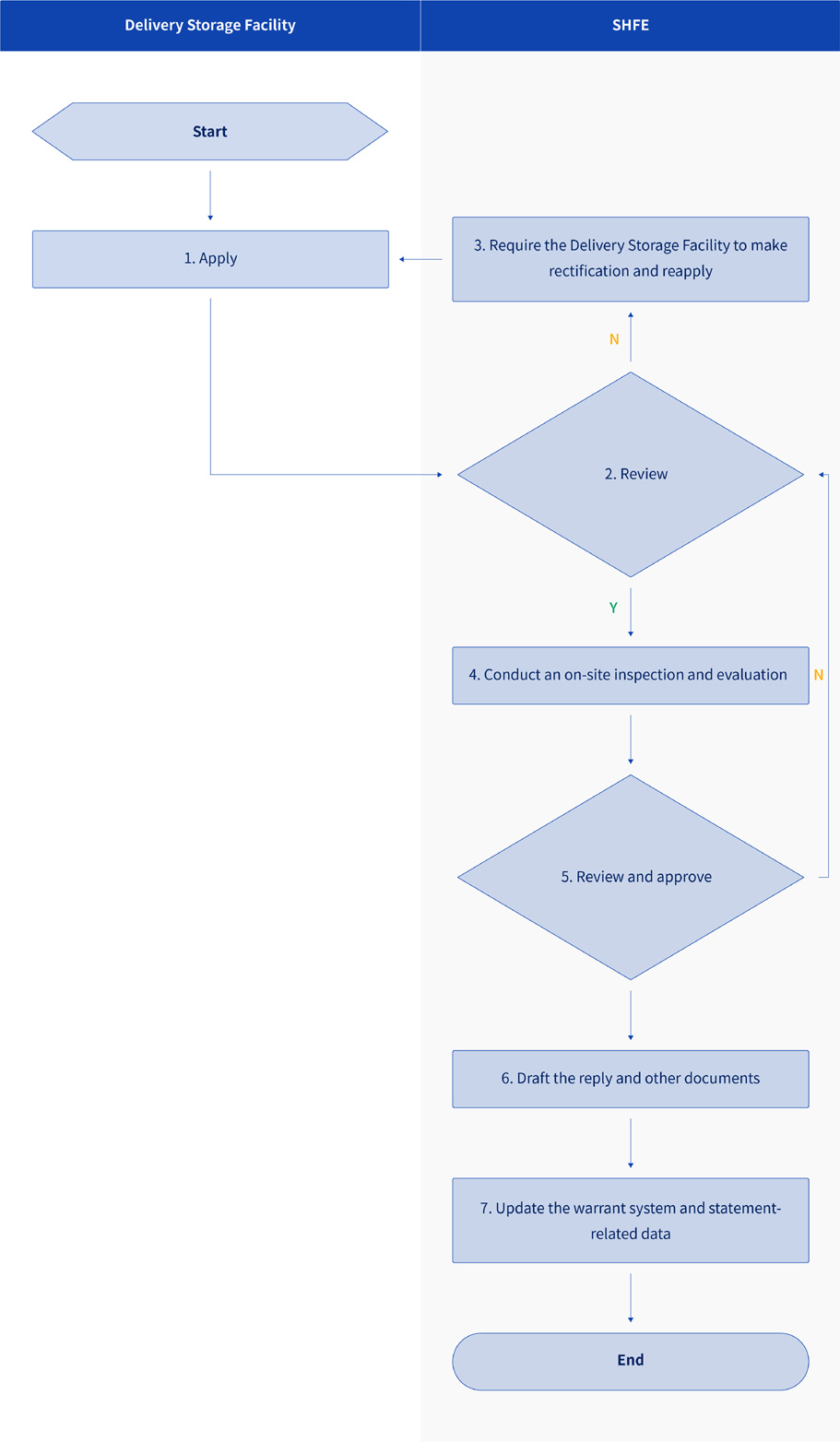
1.  The Delivery Storage Facility applies to SHFE for a change, such as change of name, storage capacity, storage address, or storage area; 
2.  SHFE conducts a preliminary review of the application;
3.  If the application passes the preliminary review, SHFE will conduct an on-site inspection; 
4.  If the application passes the on-site inspection, SHFE will approve the change (such as change of storage capacity, storage address, and storage area);
5.  SHFE publicly announces the change after the Delivery Storage Facility has updated the corresponding warrant system information and data.

Flowchart

Inspection of Delivery Storage Facilities
Description
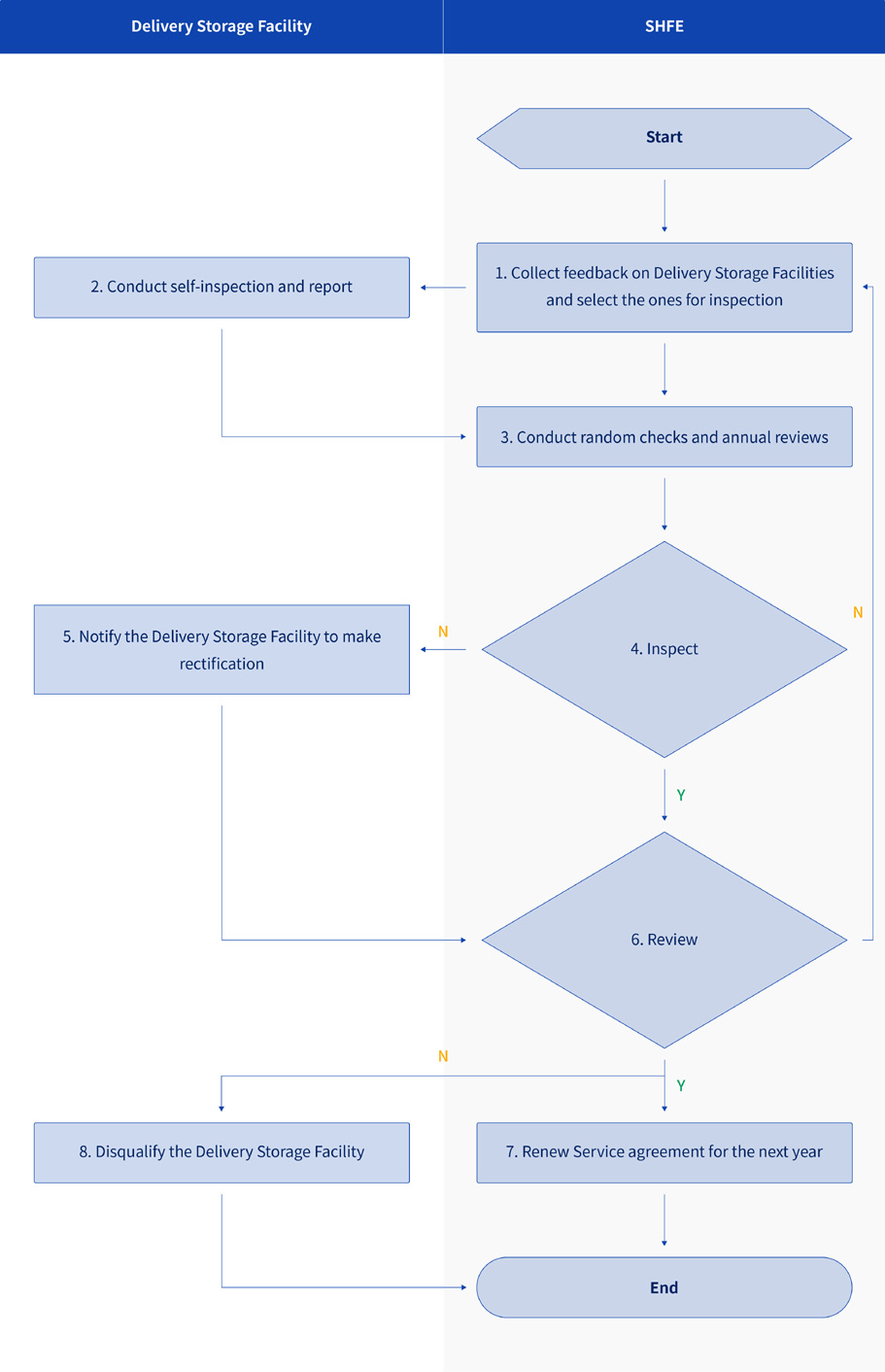
1.  SHFE collects Client complaints and other information about Delivery Storage Facilities; 
2.  Each Delivery Storage Facility carries out one comprehensive review each year, completes a self-inspection report, and submit an annual summary to SHFE;
3.  SHFE conducts random checks, on-site inspections, and annual reviews on Delivery Storage Facilities; 
4.  SHFE assesses and evaluates Delivery Storage Facilities based on the results of random checks, inspections and annual reviews;
5.  SHFE issues a notice of rectification to Delivery Storage Facilities that do not pass the review process; 
6.  SHFE renews its agreement with Delivery Storage Facilities that pass the review process;
7.  Delivery Storage Facilities that eventually fail the review process will be disqualified.

Flowchart
 

Contact information

  Non-ferrous metals:
  Natural rubber:
  Precious metals:
 
  Ferrous metals:
  Woodpulp and offset paper:
  Fuel oil and bitumen:
More

Delivery Default

Overview

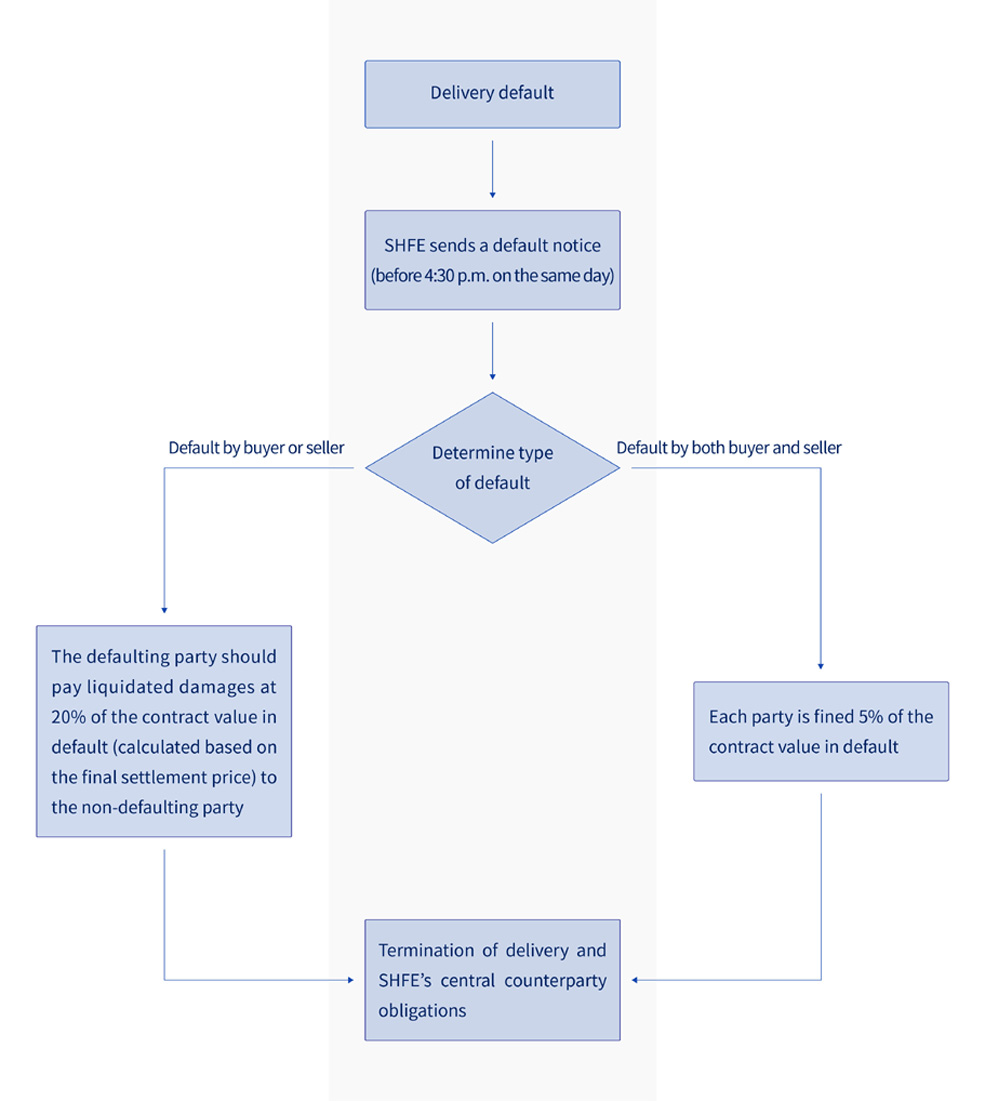
"Delivery default" means the failure of a trading party to fulfill its delivery obligations within the delivery period specified in a futures contract. Any of the following acts constitutes a delivery default: A seller fails to deliver the required number of standard warrants within the specified delivery period; a buyer fails to make delivery payment in the required amount within the specified delivery period; and other acts deemed as a delivery default by SHFE.


SHFE will investigate delivery defaults and handle them in accordance with the Enforcement Rules of the Shanghai Futures Exchange to maintain a smooth market.

More

Process

 Delivery defaults may result in a notice of default and termination of delivery. These responses are governed by the Delivery Rules of the Shanghai Futures Exchange and the Enforcement Rules of the Shanghai Futures Exchange.


More

Bonded Delivery

Overview

"Bonded delivery" refers to the physical delivery of a futures contract's underlying commodity that is under supervision as bonded goods in a customs special supervision area or a bonded supervision premise. For futures products that offer bonded delivery, the trading, clearing, and settlement procedures still remain the same. The only change is that they will be delivered through bonded delivery with bonded standard warrants.

More

Process

Bonded futures delivery encompasses the creation of bonded standard warrants, the delivery of bonded standard warrants at contract expiration, and EFP with bonded standard warrants. These procedures are mainly governed by the Delivery Rules of the Shanghai Futures Exchange .

More

Procedures

Creation of bonded standard warrants
Description
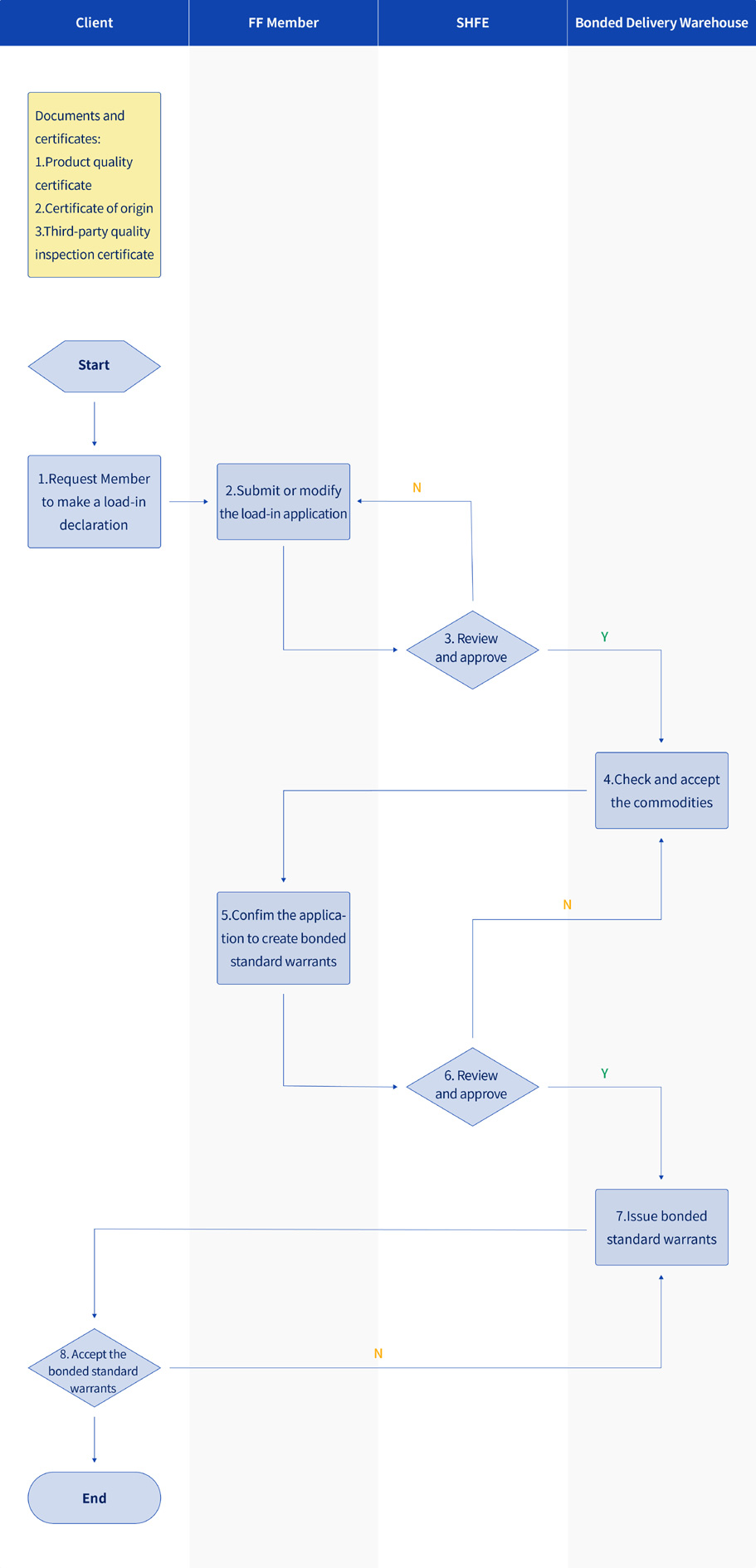
1.  The Client requests its carrying Member to complete the load-in declaration;
2.  The Member submits the declaration through the electronic warrant system;
3.  SHFE completes the approval process within 3 business days based on the capacity of the corresponding Delivery Storage Facility;
4.  The Delivery Storage Facility checks the goods to be loaded in and the supporting documents;
5.  The Delivery Storage Facility completes warrant approval and issues the bonded standard warrants; 
6.  The Client checks and accepts the bonded standard warrants.

Rules

Flowchart


Delivery of bonded standard warrants at contract expiration
Description
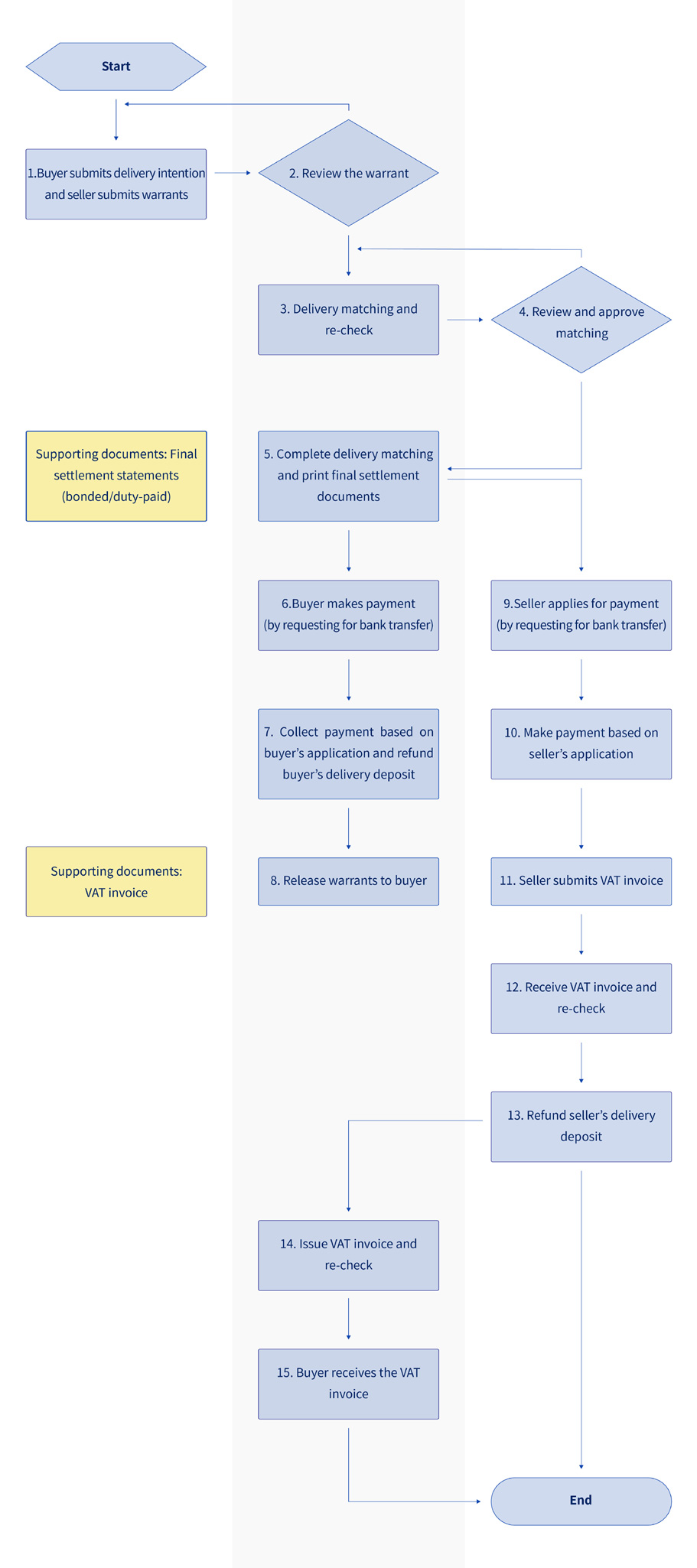
1.  First delivery day: buyer submits delivery intention and seller submits standard warrants;
2.  Second delivery day: SHFE allocates the standard warrants; buyer makes payment and receives the standard warrants; seller receives the payment.

Rules

Contact information
Guo Yichuan
Tel: 021-68400867

Flowchart


EFP with bonded standard warrants

Description
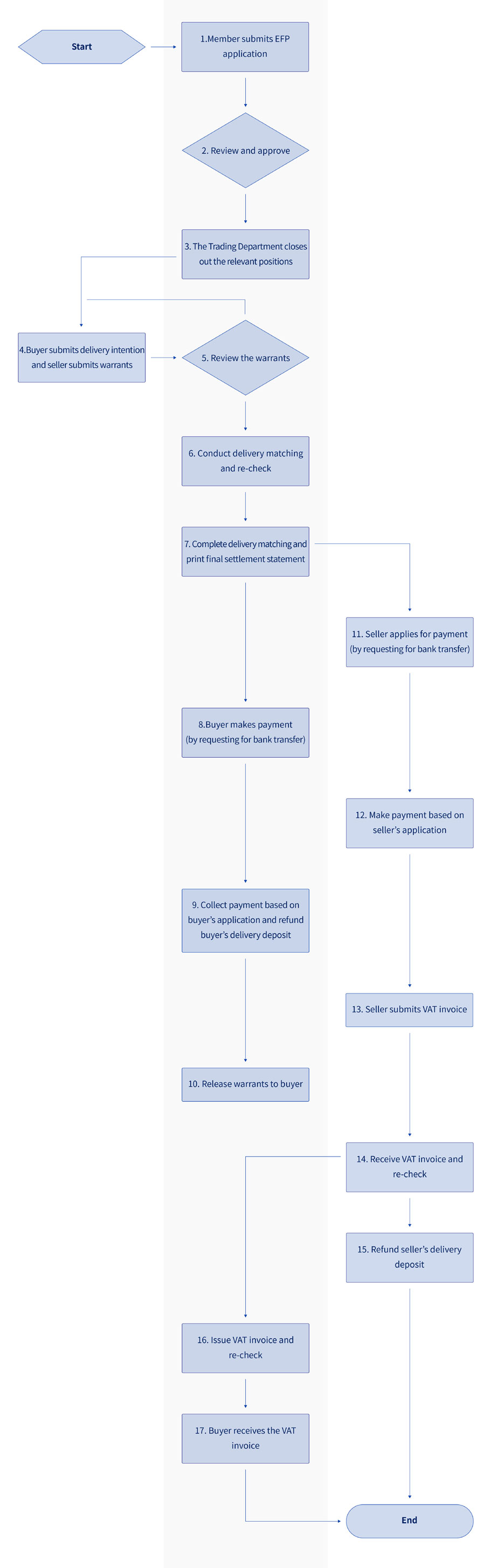
1.  Buyer and seller conclude an intention off-exchange for EFP; 
2.  Buyer and seller each submits an application for EFP via their carrying Members: buyer submits the buy intention and seller submits the warrants;
3.  SHFE closes out the corresponding futures positions after approving the application;
4.  Buyer makes payment via its Member and SHFE releases the warrants after receiving the payment;
5.  Issuance of VAT invoices: first by seller to its Member, then by the Member to SHFE, then by SHFE to buyer's Member, and lastly by the Member to the buyer.

Contact Information
Mr. Wang
Tel: 021-68401225

Flowchart