





Clearing
Overview
Clearing refers to the calculation and transfer of margin, profits and losses, transaction fees, delivery payments, and other relevant funds of Members pursuant to the trading results and the rules of SHFE. RMB is the settlement currency at SHFE. The minimum clearing deposit of a Member should be paid in RMB with its own funds. Payables such as profits and losses, fees, and delivery payments should be paid in RMB in cash.
Clearing Procedures
SHFE implements daily mark-to-market, which means that after market close on a trading day, SHFE will clear the profits and losses, trading margin, fees, taxes, and other charges for all contracts based on their corresponding settlement prices for that day, and transfer the net balance of receivables and payables by adding it to or deducting it from the relevant Members'clearing deposit accordingly.
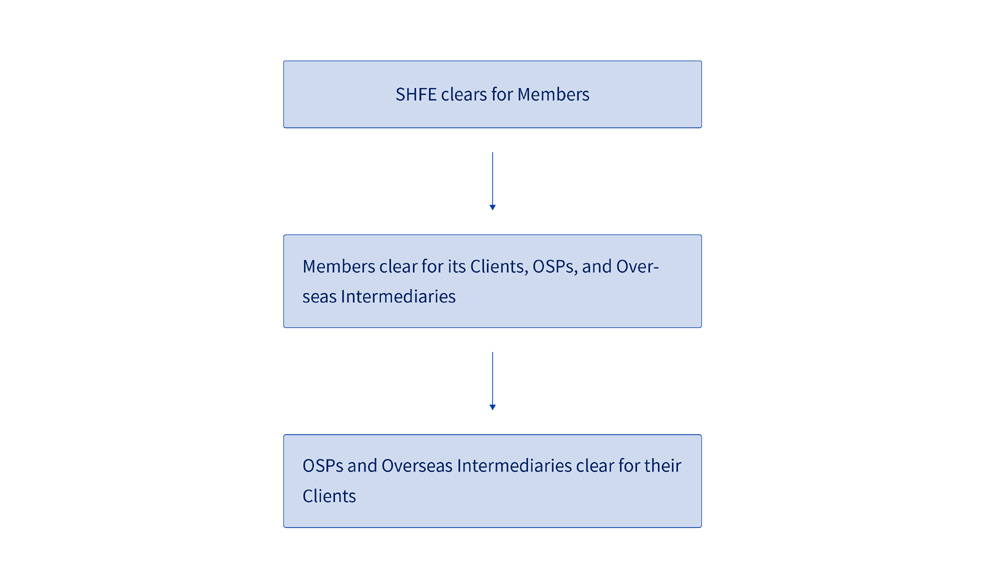
SHFE performs clearing for Members. Each FF Member clears for its Clients, the Overseas Special Participants ("OSPs") that clear trades through the FF Member, and the Overseas Intermediaries that trade and clear trades through the FF Member. Each OSBP or Overseas Intermediary clears for its Clients.
References
1. Clearing Rules of the Shanghai Futures Exchange
3. Fee schedule
Account and Funds Management
Account segregation
SHFE maintains a ledger for each Member to record and verify such amounts of the Member as funds deposits and withdrawals, profits and losses, option premiums, trading margin, and fees in chronological order on a daily basis.
Similarly, each FF Member, OSBP, and Overseas Intermediary is required to maintain a ledger for each Client to record and verify such amounts of the Client as funds deposits and withdrawals, profits and losses, option premiums, trading margin, and fees in chronological order on a daily basis.
Funds transfers between an FF Member and its Client for futures trading should be conducted through the FF Member's dedicated margin account and the Client's futures settlement account.
Designated Depository Banks
SHFE recognizes Designated Depository Banks for the safe custody of futures margin in a prudent manner. See the link below for a list of these Designated Depository Banks.
Futures margin depository business at SHFE is classified into margin depository business for domestic Clients and margin depository business for overseas Clients. "Margin depository business for domestic Clients" refers to the margin depository business related to Members and domestic Clients; "margin depository business for overseas Clients" refers to the margin depository business related to OSPs, Overseas Intermediaries, and overseas Clients. The margin depository business for QFIIs and RMB Qualified Foreign Institutional Investors (RQFIIs) (together "QFIs") that engage in futures trading and related activities in the Chinese Mainland is managed as margin depository business for domestic Clients.
CFMMC's Measures for the Administration of Margin Segregation at Futures Companies requires any Client that engages in futures trading to open or designate a settlement account opened in its own name at a Designated Depository Bank as its futures settlement account for depositing and withdrawing margin. This account needs to be registered with the relevant futures firm before funds deposits and withdrawals. A Client may register with the same futures firm multiple futures settlement accounts opened at different Designated Depository Banks. Any change of account should also be registered with the relevant futures firm.
Types of Margin
Margin is classified into trading margin and clearing deposit.
Trading margin is the portion of margin already in use to maintain existing open positions.
Clearing deposit is the portion of margin that is not yet used by existing open positions.
The minimum clearing deposit balance is RMB 2,000,000 for FF Members and RMB 500,000 for Non-FF Members.
Calculation of Margin
Margin for futures
After a futures trade is executed, SHFE will collect trading margin at a prescribed percentage of the contract value or using another method specified by SHFE. See the settlement parameters for the margin rate for various products.
SHFE may collect trading margin based on the gross positions (both long and short), net positions, or portfolios. SHFE may collect trading margin from only one side in the following circumstances:
1. a Client holds both long and short positions in the same product through the same FF Member or OSBP (except for those futures contracts held after market close on the 5th trading day preceding the last trading day), whichever side has a higher margin requirement;
2. a Non-FF Member or OSNBP holds both long and short positions in the same product through SHFE (except for those futures contracts held after market close on the 5th trading day preceding the last trading day), whichever side has a higher margin requirement;
3. any other circumstances otherwise deemed necessary by SHFE.
Margin for options
In an options trade, the option buyer pays the applicable premium, without the need to pay the trading margin, while the option seller receives the premium and needs to pay the trading margin. The trading margin rate applicable to an option seller is the higher of:
1. settlement price of the option contract × contract size of the underlying futures contract + trading margin for the underlying futures contract – (1/2) × out-of-the-money amount of the option contract;
2. settlement price of the option contract × contract size of the underlying futures contract + (1/2) × trading margin for the underlying futures contract.
Where:
Out-of-the-money amount of a call option contract = Max (strike price – settlement price of the underlying futures contract, 0) × contract size of the underlying futures contract;
Out-of-the-money amount of a put option contract = Max (settlement price of the underlying futures contract – strike price, 0) × contract size of the underlying futures contract.
References
Margin Collaterals
Upon SHFE's approval, standard warrants, foreign currencies, and Chinese government bonds may be posted as margin. With the exception of foreign currencies, the maximum amount of margin paid by a Member with such assets may not exceed four times its current cash balance.
To post marketable securities as margin, Clients, OSPs, and Overseas Intermediaries should complete the relevant procedures through their FF Members.
Standard warrants
When posted as margin, the post-haircut value of standard warrants may not exceed 80 percent of their market value.
Their market value is determined by the current-day settlement price of the nearest futures contract of the corresponding product.
Before market close, the market value is tentatively calculated from the settlement price of the nearest futures contract of the corresponding product on the trading day before the day the standard warrants are posted.
Standard warrants may be posted as margin during 9:00 a.m. – 3:00 p.m. and 9:00 p.m. – 2:30 a.m. (+1), and released as margin during 9:00 a.m. – 2:30 p.m.
Chinese government bonds
At present, of all government bonds, only book-entry Chinese government bonds (CGBs) issued in the Chinese Mainland by the Ministry of Finance can be used as margin. Each time CGBs are posted as margin, their total face value should be at least RMB 1,000,000. The post-haircut value of CGBs may not exceed 80 percent of their market value.
CGB's benchmark price is the lowest of the valuations provided by depositories. At daily clearing, SHFE determines the market value of a CGB based on the net price of its benchmark price on the preceding trading day.
CGBs may be posted or released as margin during 9:00 a.m. – 2:30 p.m.
Foreign currencies
According to current Exchange rules, only US dollars can be accepted as margin at a haircut of 0.05.
The market value of foreign currencies is calculated from the current-day Central Parity Rate published by CFETS (China Foreign Exchange Trade System).
Foreign currencies may be posted as margin during 8:00 a.m. – 3:00 p.m. and 8:15 p.m. – 2:30 a.m. (+1), and released as margin during time of settlement.
Note: See the Clearing Rules of the Shanghai Futures Exchange for the rules on posting assets as margin.
EFP
Exchange of futures for physicals ("EFP") is the process where a buyer and a seller who hold opposite positions in a futures contract expiring in the same month agree to, subject to SHFE's approval, tender a notice of EFP to have their respective positions in such contract closed out by SHFE at the price prescribed by SHFE; then at the price agreed upon, the seller transfers to the buyer the warrant of the same quantity and the same or similar type of underlying commodity as the futures contract.
Application criteria
EFP is only applicable to existing positions on SHFE-listed contracts opened prior to the date of the EFP application, but not to the positions newly opened on that day.
Application period
EFP may be initiated from the listing day of the contract intended for EFP to the second trading day (including that day) prior to the last trading day.
After the buyer and the seller (or their carrying Members) holding opposite positions on a futures contract of the same delivery month reach an EFP agreement, either of them may submit an EFP application to SHFE via the Standard Warrant Management System before 2:00 p.m. on any trading day within the aforementioned period. The EFP is executed after the application is confirmed by the other party and approved by SHFE.
Application process
Procedures
On the day of application, if the EFP application is duly completed, SHFE will close out the relevant positions before 3:00 p.m. at the settlement price for the trading day preceding the application day.
On the trading day following the application day, for an SHFE-settled EFP, payment and special VAT invoice will be handled as in a delivery at contract expiration; for an EFP to be settled by the parties themselves, the buyer and seller will arrange for the exchange of payment and tax invoice without SHFE's involvement.
Note: For the specific steps, refer to the Delivery Rules of the Shanghai Futures Exchange and the product-specific rules.
References
Transfer of Positions in Delivery Month
Application criteria
Application time and requirements
Application method
After the transferor and the transferee confirm the actual control relationship between them has taken effect, the transferor's FF Member will submit the transfer application for confirmation by the transferee's FF Member. See the SHFE Guidelines for Transfer of Positions in the Delivery Month for details.





 沪公网安备 31011502008304号